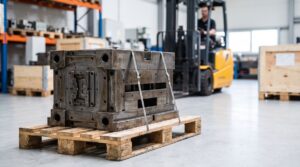

2K moulding — also called two-shot, two-component, or bi-component moulding — produces a single finished part from two different materials in one automated cycle, inside one machine. A hard plastic and a soft grip. Two bonded colours. A rigid frame with an integral seal. The appeal is obvious: you collapse what used to be two moulding jobs plus an assembly step into one operation, and you get a part that can’t fall apart at the join because there is no join to fail.
But 2K is not automatically the right answer. The tooling costs more, the process is less forgiving, and below a certain volume it never pays back. This guide is about when two-shot moulding earns its place and why — and, just as importantly, when a simpler route will serve you better. It’s written for the engineers and procurement managers who have to sign off the tooling quote, not for anyone trying to sell you a machine.
What 2K moulding actually is
In conventional injection moulding, one material is injected into one cavity to make one part. In 2K moulding, two materials are injected in sequence into the same tool to make one part — the second shot bonds to or locks around the first while it’s still in the machine. The result is a single integrated component rather than two parts that were made separately and joined later.
You’ll meet the process under several names. “Two-shot” describes the two injection stages. “Two-component” or “bi-component” describes the two materials. “Multi-shot” is the umbrella term once you go beyond two materials. They all refer to the same basic idea, and 2K sits within the wider family of injection processes covered in our guide to the different types of injection moulding.
How a 2K injection moulding machine works
A 2K machine has two injection units — two barrels, two screws — feeding one clamping area. The first shot is moulded exactly as it would be on a standard machine. Then, instead of being ejected, that first-shot part is moved to a second position where the second material is injected over or around it. Three methods dominate how that transfer happens:
- Rotary platen (the most common): the moulded first shot stays on the core, and the mould half rotates 180° to present it to the second injection unit. The second shot is moulded over it, then the finished part is ejected. Fast, repeatable, ideal for high volumes.
- Core-back (core-pull): a section of the cavity is retracted after the first shot, opening up space the second material fills. No rotation — useful for simpler two-material parts and lower tooling cost.
- Transfer / robotic: a robot lifts the first shot out and places it into a second cavity (sometimes a second machine). The most flexible approach and the bridge between true 2K and over-moulding.
The critical detail in every method is timing and temperature. The first shot must be cool enough to hold its shape but, for a chemical bond, the surface must still be receptive when the second material hits it. Get the cooling window wrong and you get poor adhesion, flash, or warping. This is the main reason 2K demands more process control than single-shot moulding.
Material pairings: what bonds to what
The single biggest factor in whether a 2K part succeeds is material compatibility. Two materials sharing a cycle does not guarantee they’ll bond. There are three broad pairing strategies:
- Hard + soft (rigid + elastomer): the classic use case — a rigid structural substrate such as PP, ABS, PC or nylon with a soft TPE or TPU over-layer for grip, sealing or cushioning. Toothbrush handles, power-tool grips, razor handles, gaskets moulded straight onto a housing.
- Two colours of the same polymer: easy to bond because the materials are chemically identical. Used for moulded-in buttons, indicators, illuminated symbols (a translucent shot behind an opaque one), and durable two-tone branding that won’t scratch off like paint.
- Two different rigid polymers: the hardest to get right — combining, say, a transparent and an opaque engineering plastic, or two materials with very different shrinkage. Often needs a mechanical interlock designed into the part rather than relying on a chemical bond alone.
Bond compatibility is published by material suppliers in adhesion charts, but charts are a starting point, not a guarantee — surface geometry, gate position and process temperatures all move the result. Where a chemical bond is marginal, good 2K design adds mechanical retention (undercuts, through-holes the second shot flows into, dovetail shut-offs) so the part holds together even if adhesion is imperfect. The materials decision overlaps heavily with the broader trade-offs in how automotive and medical injection moulding differ — sealing, biocompatibility and chemical resistance all narrow the shortlist.
2K moulding vs over-moulding: the distinction that matters
These two get conflated constantly, and the difference has real cost and quality consequences.
- 2K (two-shot) moulding: both shots happen in one machine, one automated cycle. The first shot never leaves the tool before the second is applied. Higher tooling cost, lower per-part cost, best contamination control, best bond consistency — because the substrate surface is fresh and never handled.
- Over-moulding (insert moulding): the first part (or a metal insert) is moulded or made separately, then loaded — by hand or robot — into a second tool for the over-mould. Cheaper tooling, more flexible, but slower, more labour, and the substrate surface may have cooled, oxidised or picked up contamination, which can weaken the bond.
Rule of thumb: choose true 2K when volumes are high and bond integrity is critical (medical seals, automotive components that must not delaminate). Choose over-moulding for lower volumes, for encapsulating metal inserts, or when you want to validate a design before committing to expensive 2K tooling.
When to choose 2K — and when not to
2K moulding is the right call when:
- The part genuinely needs two materials — a hard structure and a soft seal or grip, or two integral colours — and assembling them separately would add cost, labour or a failure point.
- Volumes are high enough to amortise the tooling. Two-shot tools are typically 40–80% more expensive than an equivalent single-shot tool, so the saving on assembly and secondary operations has to outrun that premium.
- You want to eliminate post-mould operations — painting, bonding, ultrasonic welding, manual assembly — and the quality and consistency that come with removing those steps matter.
- A moulded-in finish needs to survive wear that paint or pad-printing wouldn’t.
Think twice when: volumes are low or uncertain; the design is still changing (every change means re-cutting a complex tool); one material would actually do the job; or your two materials simply won’t bond reliably and the part can’t accommodate a mechanical interlock. In those cases single-shot moulding plus assembly, or over-moulding, is usually the smarter spend.
The real cost picture
2K economics are a trade between a higher fixed cost (tooling) and a lower variable cost (per part). The two-shot tool is more expensive because it carries two cavities, the rotation or core-back mechanism, and far more demanding precision — the shut-off faces between the two materials have to seal perfectly or you get flash and bleed.
You earn that premium back on every part, because you remove:
- A second moulding set-up and its machine time
- Manual or automated assembly labour
- Adhesives, fasteners or welding operations
- The scrap and rework that assembly steps generate
The honest answer to “is it worth it?” is volume-dependent. As a working guide, 2K tends to pay back somewhere in the tens of thousands of parts per year and becomes compelling in the hundreds of thousands — but the exact break-even depends entirely on how much assembly cost you’re removing. A part that needed three manual assembly steps reaches break-even far sooner than one that just needed two colours. The right way to decide is a side-by-side total-cost comparison — tool plus per-part plus assembly — over your real annual volume, not a glance at the tooling quote alone.
Where 2K moulding is used
- Automotive interiors: soft-touch switches and trim, sealed buttons, two-colour control panels, illuminated symbols that glow through a translucent second shot, and gaskets moulded directly onto housings to keep dust and moisture out.
- Medical devices: ergonomic soft grips on rigid instruments, integral seals and valves, and housings where a moulded-in seal removes a contamination-prone assembly join — a real advantage where sterility and traceability are non-negotiable.
- Electronics & consumer: connector housings with integral seals, water- and dust-resistant enclosures, wearables, and durable two-tone branding on tools, appliances and personal-care products.
The common thread: every one of these either needs two material properties in one part, or replaces an assembly step that used to be a cost and a reliability risk.
Designing for 2K: what to get right early
2K rewards design decisions made before the tool is cut and punishes the ones left too late. The essentials:
- Confirm the bond first. Validate your hard/soft or polymer pairing against supplier adhesion data and, ideally, a test moulding — before committing to tooling.
- Add mechanical retention. Don’t rely on chemical adhesion alone where the bond is marginal. Undercuts and flow-through features let the second shot lock on mechanically.
- Design clean shut-offs. The faces where the two materials meet must seal under pressure, or the second material bleeds into the first. This is where 2K tools succeed or fail.
- Account for differential shrinkage. Two materials cool and shrink at different rates; mismatches cause warping and internal stress. Wall sections and the bond geometry have to absorb it.
- Plan the first shot for handling the second. The substrate has to stay located and dimensionally stable while the second shot is injected.
Get a moulder involved at the design stage. The cost of a DFM review is trivial next to the cost of re-cutting a two-shot tool because two materials wouldn’t seal.
How Sino approaches 2K moulding
Sino has run plastic injection moulding for nearly two decades, with 2K capability in our Shenzhen factory alongside our wider injection and tooling operations. As a British-Chinese manufacturer, we sit between Western engineering expectations and Chinese production scale — which in practice means we’ll tell you honestly when 2K is the right process and when it isn’t. If your volumes don’t justify the tooling, or a single-shot part with a separate seal would serve you better, that’s the advice you’ll get. Where 2K is the right answer, we validate the material pairing and shut-off design up front so the bond is right the first time. It’s part of the broader capability set in our complete guide to injection moulding.
Frequently asked questions
Is 2K moulding the same as over-moulding?
No. In 2K (two-shot) moulding both materials are moulded in one machine in a single automated cycle, with the first shot never leaving the tool. In over-moulding the first part or insert is made separately and then loaded into a second tool. 2K gives better bond consistency and lower per-part cost at volume; over-moulding has cheaper tooling and more flexibility at lower volumes.
How much more does a 2K mould cost?
Typically 40–80% more than an equivalent single-shot tool, because it carries two cavities, a rotation or core-back mechanism, and tighter precision on the shut-off faces. The premium is recovered through removed assembly and secondary operations, so whether it’s worth it depends on your annual volume.
Which materials can be used together in 2K moulding?
The most common pairing is a rigid substrate (PP, ABS, PC or nylon) with a soft TPE or TPU over-layer. Two colours of the same polymer bond easily; two different rigid polymers are the hardest and often need a designed-in mechanical interlock. Always check supplier adhesion data for your specific pair.
What’s the minimum volume to justify 2K moulding?
There’s no single number — it depends on how much assembly cost 2K removes. As a guide it becomes attractive in the tens of thousands of parts per year and compelling in the hundreds of thousands. Below that, single-shot moulding plus assembly, or over-moulding, is usually cheaper overall.
The bottom line
2K moulding is a powerful process when the part genuinely needs two materials and the volume is there to pay for the tooling. It removes assembly steps, eliminates failure-prone joins, and produces consistent, durable multi-material parts at scale. But it’s a commitment — more expensive tooling, tighter process control, and unforgiving material chemistry. The smart move is to model the total cost against your real volume and validate the material bond before you cut a tool. If you’re weighing 2K against over-moulding or single-shot assembly for a specific part, talk to our team — we’ll give you a straight answer on which one actually makes sense.
Need help with a project?
Choosing the right moulding method is crucial. Whether you need durable automotive parts, precision electronics components, or customised medical devices — Sino’s team will help you get it right from the start.
We’ll complete an NDA and provide expert advice tailored to your requirements, timescale and budget.