

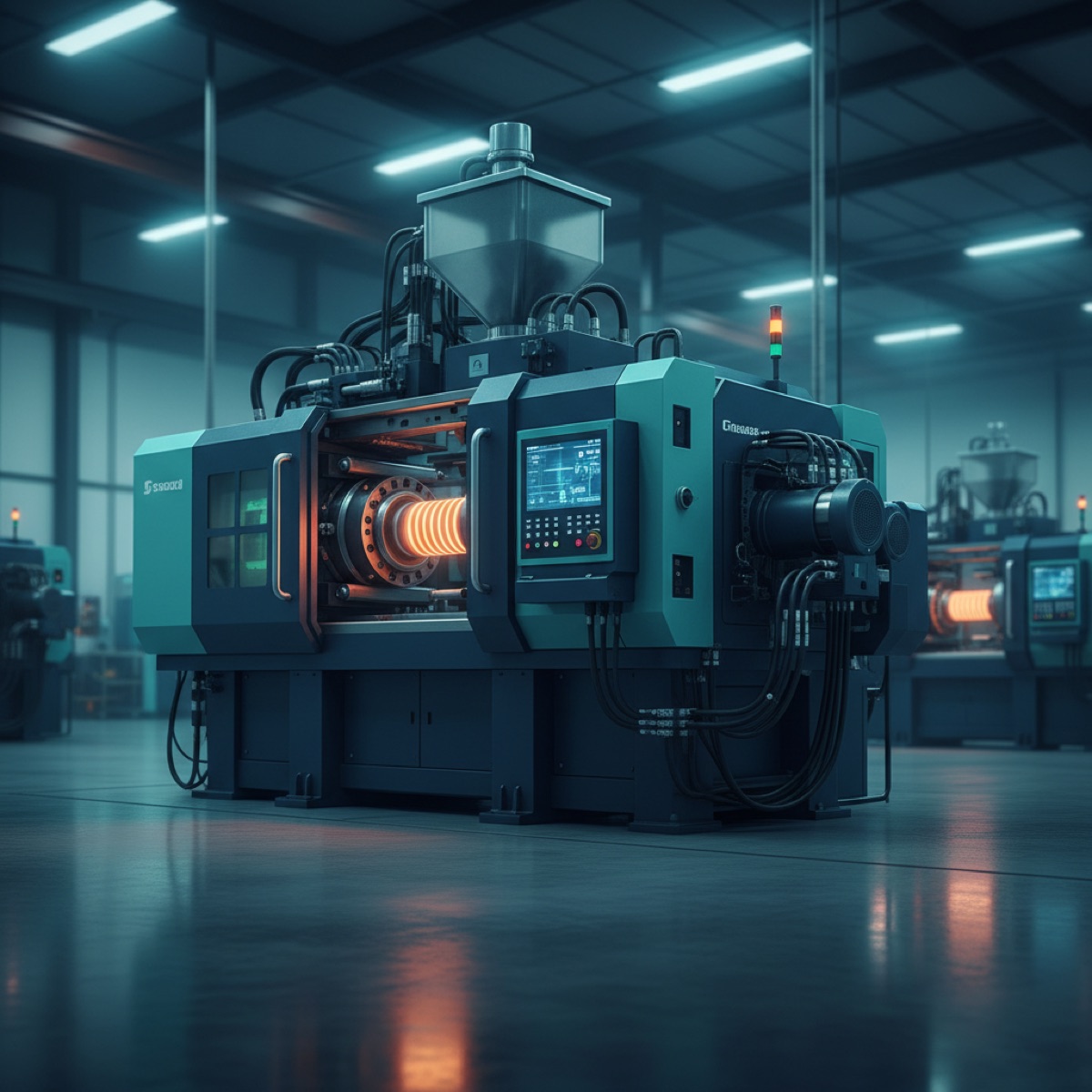
Injection molding is the most widely used manufacturing process in the world for producing plastic parts in large volumes. From your shampoo bottle to your car dashboard, the connectors of a medical device or the components of a home appliance, virtually any plastic product you touch every day came out of an injection molding machine.
But although the principle is simple —melt plastic, inject it into a mold, cool it, and eject it—, behind every well-made part there are technical decisions that determine whether your product reaches the market on time, with the right quality and at the expected cost. A bad decision in mold steel type, material, or design can cost hundreds of thousands of dollars and delay a launch by entire months.
This guide covers everything a manufacturer, product engineer, or purchasing manager needs to understand about injection molding in 2026: how the process works step by step, what types exist, what materials are used, what defects to watch for, which industries benefit most from it, and —most importantly— how to choose a supplier that is a true partner and not just a parts vendor.
What is injection molding?
Injection molding is a manufacturing process in which a thermoplastic (or in specific cases a thermoset or elastomer) is melted and injected under high pressure into a closed metal mold. The material fills each cavity of the mold, cools until it solidifies, and is ejected as a finished part.
What makes this process so dominant in modern manufacturing is the combination of three factors:
- Volume. A single machine can produce between 500 and 10,000 parts per day depending on the size and complexity of the part.
- Repeatability. Parts come out identical —typical tolerances are around ±0.1 mm, and in medical applications can reach ±0.025 mm.
- Design freedom. Complex geometries, internal ribs, metal inserts, multiple materials in a single part: everything is possible.
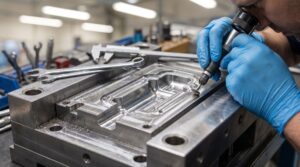
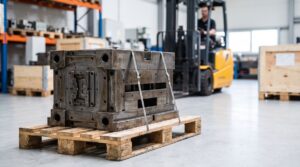
The cost per part is very low once the mold is made. The challenge is that the mold itself (known as tooling) can cost from $4,000 for a simple part to several hundred thousand dollars for a high-precision multi-cavity mold. That initial investment is the reason injection molding is justified starting at volumes of around 1,000 parts per year —below that, it is worth considering 3D printing or CNC machining.
How it works: the 6 steps of the injection molding process
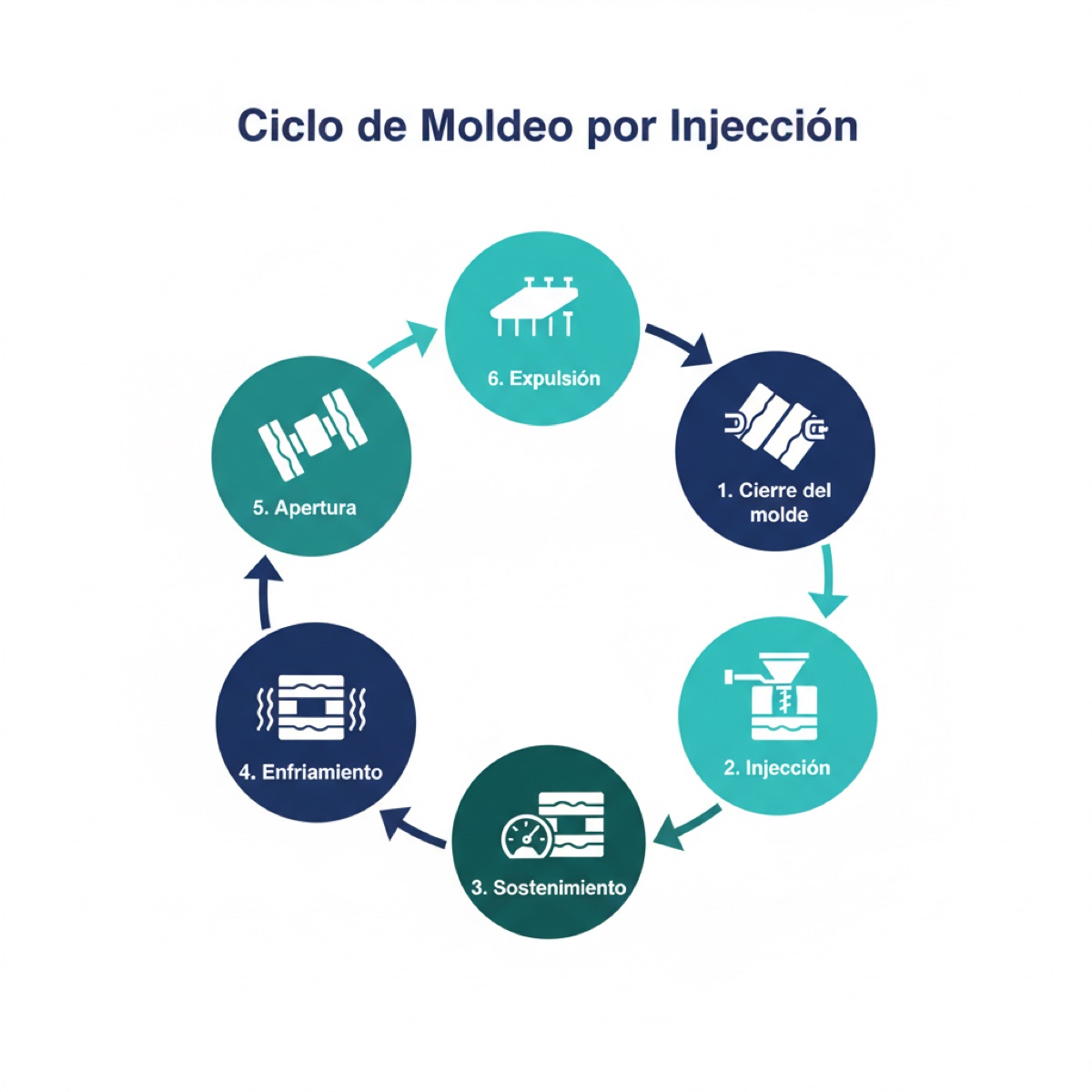
The complete cycle of a molded part takes between 15 and 60 seconds, and is divided into six clear stages:
- Feeding and melting. Plastic pellets enter through the hopper into the barrel, where a rotating screw transports them forward. Friction and barrel electric heaters melt the material, raising it to temperatures between 180°C and 320°C depending on the polymer.
- Mold clamping. The two mold halves are joined with a clamping force that can range from 20 tons (small parts) to 3,000 tons (large parts like bumpers).
- Injection. The screw advances like a piston and pushes the molten plastic through the nozzle into the mold. The typical injection pressure is 700 to 2,000 bar. This step takes 0.5 to 5 seconds.
- Holding. Pressure is maintained on the material to compensate for contraction as it begins to cool. This stage prevents defects such as sink marks and voids.
- Cooling. The mold has internal water channels that extract heat from the part. This step is typically the longest in the cycle —representing between 60% and 80% of the total time— and must be carefully designed to prevent warping.
- Opening and ejection. The mold opens and ejector pins push the part out. A robotic arm retrieves it or it falls by gravity into a container. The cycle begins again.
A well-optimized process maintains consistent cycle times within ±0.5 seconds. Greater variations are a sign of problems in temperature, cooling, or feeding.
Types of injection molding
Not all injection molding is the same. Depending on the complexity of the part, the materials involved, and the final application, there are several process variants. Knowing them helps you correctly specify your product and compare quotes from different suppliers.
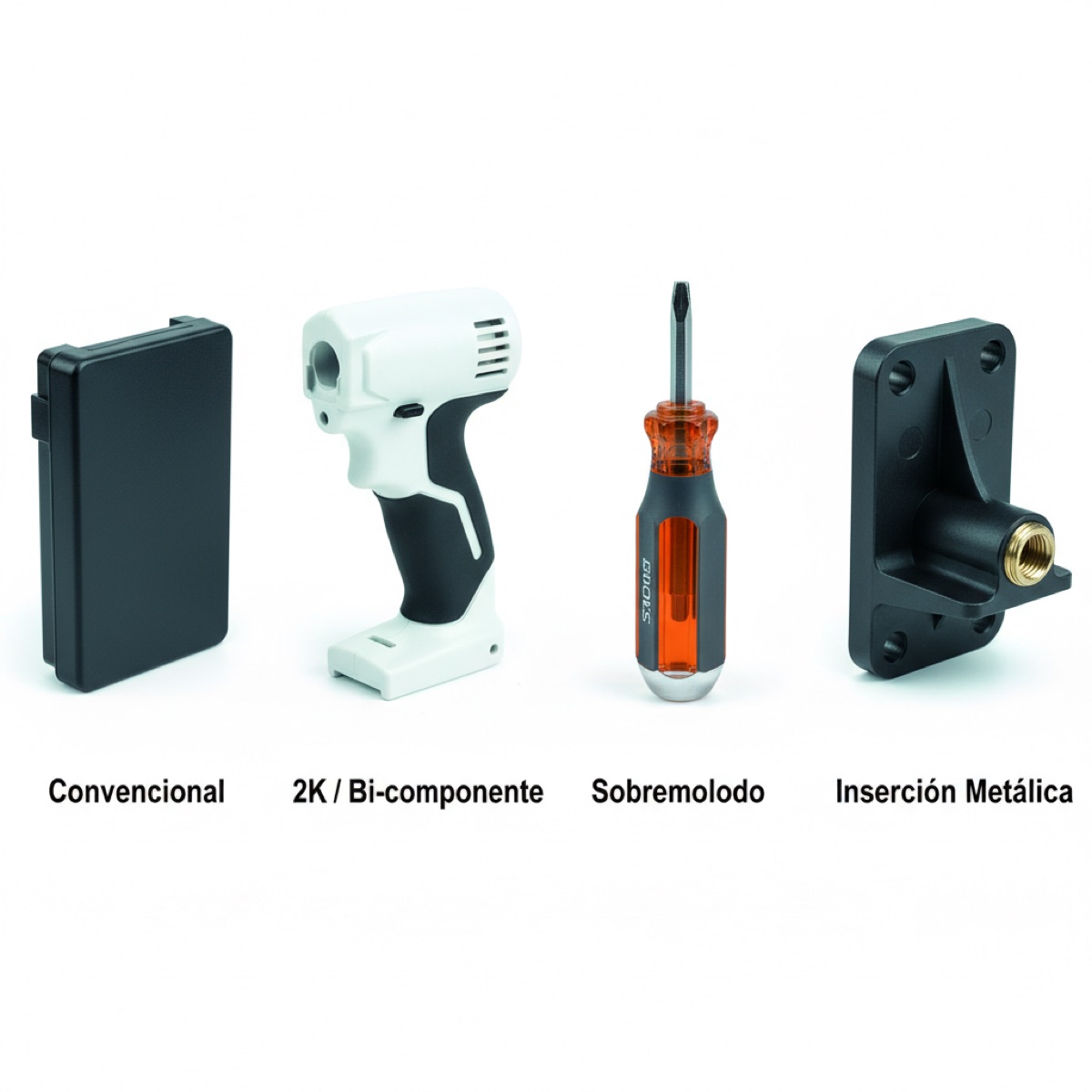
| Type | When to use it | Advantages | Limitations |
|---|---|---|---|
| Conventional | Single material and single color parts. The majority of cases. | Lower tooling cost, shorter cycles, mature process. | Does not combine materials or generate soft/hard zones in a single part. |
| 2K (bi-component) | Parts with two materials in a single operation: soft grip over rigid base, integrated seals, multicolor buttons. | Eliminates post-assembly, improves aesthetics, reduces production costs. | More complex mold and machine (dual injection unit), higher initial cost. |
| Overmolding | Molding plastic over a previously molded part or other substrate. | Longer cycle, requires handling between stages, risk of poor adhesion. | Ciclo más largo, requiere manejo entre etapas, riesgo de adherencia deficiente. |
| Metal insert molding | Integrate metal components (threaded inserts, electrical terminals, screws) inside the plastic part. | Eliminates assemblies, improves mechanical resistance and conductivity. | Precise insert positioning required, cycle time increases. |
| Gas-assisted | Hollow, tubular, or thick-walled parts without sink marks. | Reduces weight and material, improves surface finish, less warping. | Diseño complejo, tecnología especializada, no disponible con todos los proveedores. |
| Thin-wall | Consumer packaging, single-use containers, lightweight casings. | Lighter and cheaper parts, very short cycle times. | Requires high speed machines and specific materials, tight tolerances. |
Most commonly used materials in injection molding
Material selection is one of the most important design decisions. A poorly chosen material can break in real conditions, degrade in the sun, not meet food contact standards or shoot up the cost per part. These are the most commonly used plastics in industrial production:
| Material | Key properties | Typical applications |
|---|---|---|
| ABS | Rigid, impact resistant, good surface finish, easy to paint. | Electronic housings, toys, automotive interiors. |
| Polypropylene (PP) | Flexible, chemical resistant, supports live hinges, approved for food contact. | Packaging, closures, automotive components, disposable medical devices. |
| Polycarbonate (PC) | Transparent, extreme impact resistance, thermally stable. | Visors, lenses, glasses, power tool housings. |
| Nylon (PA6, PA66) | High mechanical strength, good wear behavior, withstands high temperatures. | Gears, electrical connectors, mechanical components under the hood. |
| POM (acetal) | High dimensional accuracy, low friction, good chemical resistance. | Mechanical parts, zippers, precision components. |
| PEEK | High thermal and chemical performance, biocompatible. | Medical implants, aerospace, high temperature critical components. |
| TPE / TPU | Elastomeric, soft feel, good adhesion in overmolding. | Handles, seals, footwear, sports components. |
A good supplier doesn’t just inject the material you order – he helps you select it. If your product needs to meet standards such as FDA for food contact, ISO 10993 for medical devices or UL94 for flame retardancy, this should be discussed before cutting the mold, not after.
Advantages and disadvantages of injection molding
Before committing to this process, compare it honestly against alternatives such as 3D printing, thermoforming, extrusion or CNC machining.
Advantages
- Very low cost per piece in volume. From 10,000 parts per year, injection molding is usually unbeatable.
- Consistency. Millions of identical parts within tight tolerances.
- Complex geometries. Ribs, demolding angles, textures, logos: all integrated into the part.
- Wide variety of materials and colors. From engineering polymers to medical and food grades.
- Automation. The process can run 24/7 with minimal supervision.
Disadvantages
- High initial investment. Tooling can account for most of the cost at low volumes.
- Development time. Designing and manufacturing a mold takes between 4 and 16 weeks depending on complexity.
- Costly design changes. Modifying a mold after it has been manufactured is expensive and sometimes impossible.
- Geometric limitations. Parts with complex undercuts or very thin walls may require molds with runners, which increases the cost.
Common defects and how to prevent them
Even with a mature process, injection molding has recurring defects. Knowing how to recognize them and understanding their root cause saves production time and reduces rejects:
- Rechupes (sink marks). Surface depressions caused by uneven shrinkage. Solution: increase holding time, adjust temperature, redesign ribs.
- Flash. Plastic escaping between mold halves. Cause: insufficient clamping force, excessive pressure or mold wear.
- Short shots. The part does not fill completely. Solution: increase temperature, check venting, increase injection speed.
- Warping. Deformation of the part during cooling. Cause: uneven cooling, variable thickness, unsuitable material.
- Welding lines. Where two flow fronts meet and do not merge completely. Solution: redesign injection points, increase temperature.
- Burns. Dark spots caused by trapped air being compressed and heated. Solution: improve mold venting, reduce injection speed.
Applications by industry
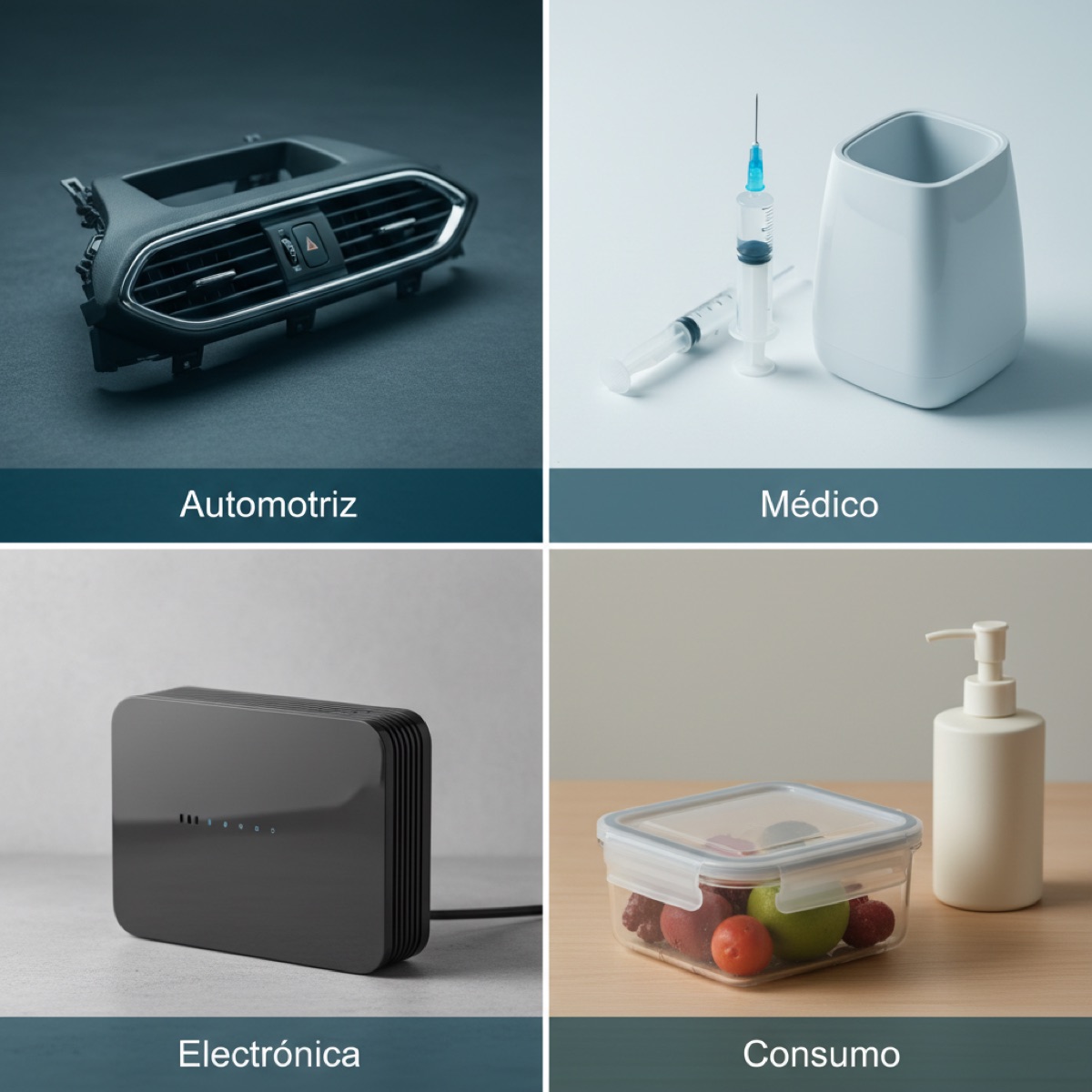
Injection molding cuts across virtually all modern manufacturing. Each industry has its own unique requirements:
- Automotive. Dashboards, bumpers, electrical connectors, under hood components, LED lights. It requires tight tolerances, thermal resistance and, increasingly, recycled grades. Standards such as IATF 16949 are mandatory.
- Physician. Syringes, device housings, diagnostic components, implants. Requires clean rooms (ISO Class 7 or 8), biocompatible materials, lot traceability and ISO 13485 certification.
- Electronics and home appliances. Housings, buttons, connectors, structural components. Combines aesthetics, impact resistance and specific electrical properties.
- Packaging and consumption. Food packaging, lids, containers, toys, sporting goods. High volume, short cycle times, FDA approved materials.
- LED lighting. Diffusers, housings, lenses. Requires optical transparency, thermal stability and heat dissipating design.
- Construction and white goods. Components for washing machines, refrigerators, electrical accessories, technical parts for installations.
How much does an injection molding project cost?
The total cost is composed of three blocks:
- Tooling (mold). Between 80,000 and 3,000,000,000 MXN depending on complexity, number of cavities, type of steel and finish. This investment is paid only once and amortized over the life of the mold (typically 500,000 to several million cycles).
- Parts. The unit cost includes material, machine-time, labor and margin. A single ABS part may cost MXN 1.50, a technical nylon part with inserts may cost MXN 20-40.
- Associated services. Design engineering (DFM), prototyping, validation, packaging, logistics, warehousing.
Beware of too low quotes on tooling: a cheap mold is often made with soft steel (untreated P20 instead of hardened H13), unbalanced cavities or no conformal cooling. In real production, these “savings” translate into longer cycle times, recurring defects and molds that fail prematurely. In molds, cheap is expensive.
Choosing the Right Injection Molding Supplier
Choosing a supplier is the most long-term decision of the project. Once the mold is cut and validated, changing it from the factory is costly and risky. Evaluate with this 7-point framework:
- Actual capacity and installed capacity. Do they have machines with the tonnage your part needs? Can they handle your volume today and triple it in 18 months?
- Certifications and quality systems. ISO 9001 as a minimum. IATF 16949 for automotive. ISO 13485 for medical. Sedex or SGS ethical audits.
- Communication. Who answers your technical questions? In what language? At what speed? One project engineer who understands your product is worth more than ten salespeople.
- Project management discipline. APQP, time master plans, project books with documented approvals, single point of contact.
- Financial stability. A supplier that closes in the middle of your project is the most expensive of all. Ask for history, seniority and portfolio of clients with long permanence.
- Geographic footprint and resilience. A single factory in a single country is a single point of failure. Suppliers with capacity in China plus nearshoring in Mexico absorb risk that you otherwise bear.
- Scalability. Can they grow with you from prototype to 1 million parts per year without needing to change suppliers and revalidate parts?
At Sino Manufacturing we operate under this model: our own factory in Shenzhen with expanding operations in Querétaro, British management with Western standards, and Spanish-speaking engineers managing each project. It’s the scheme that allows international brands to have the scale of China combined with the proximity of nearshoring and the communication that your team expects.
Frequently asked questions about injection molding
What is the minimum profitable volume for injection molding?
It depends on the size and complexity of the part, but as a general rule injection molding is justified from 1,000-5,000 parts per year. Below that volume, 3D printing, CNC machining or aluminum injection molding(soft tooling) should be evaluated.
How long does it take to make a mold?
Between 4 and 16 weeks depending on complexity, number of cavities and whether it is hardened steel or aluminum. Prototypes in aluminum molds can be ready in 2-4 weeks.
Which is cheaper: injection molding or 3D printing?
For 1-100 parts, 3D printing is more economical. For more than 1,000-5,000 parts, injection molding wins by an order of magnitude in cost per unit.
What is the difference between injection molding and blow molding?
Injection molding produces solid parts with a defined shape (caps, connectors, housings). Blow molding produces hollow parts (bottles, tanks). These are different processes with different equipment.
Can I mold several colors or materials on the same part?
Yes, by 2K molding or overmolding. These are more complex processes but allow the integration of soft and hard zones, multiple colors or functional materials in a single operation.
Next step: talk to an engineer, not a salesperson.
The best way to find out if your product is viable for injection molding – and with what material, with what type of mold, and at what cost – is a 30-minute technical conversation with an engineer who has done this job hundreds of times.
At Sino we offer that evaluation at no cost and with no obligation. We review your design, identify DFM opportunities that reduce tooling and part cost, and give you an honest picture of timing, investment and feasibility.
Talk to a Sino engineer today – free technical evaluation of your injection molding project, in Spanish, with 20+ years of experience manufacturing for international brands.