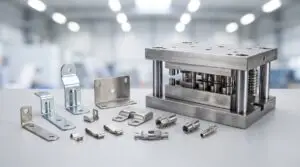

Sheet metal stamping — metal pressings in UK shorthand, metal stamping in US usage — sits behind a huge share of the parts in almost any bill of materials. Brackets, clips, shields, terminals, chassis panels, spring contacts, motor laminations, enclosures. The parts look simple. The tooling decision behind them is where a programme is quietly won or lost.
This guide is for buyers and design engineers sizing a stamping programme: what the process actually is, how to choose between single-stage, progressive and transfer tooling, what drives the unit price and the tool price, and how to tell a real stamping manufacturer from a broker with a phone and a markup.
We run metal pressings alongside injection moulding, CNC turning and die casting at our factory in Shenzhen, and support the Americas from our plant in Querétaro, Mexico. The shop-floor view below is what we tell our own customers before they commit a part to a press tool.
What sheet metal stamping actually is
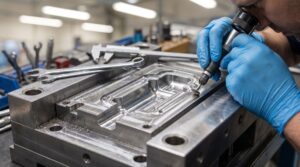
Stamping is a cold-forming process. A coil or blank of sheet metal is fed into a press, and a hardened steel tool — the die — shears, pierces, bends, coins or draws the material into shape as the press ram comes down. One press stroke can do one operation or many, depending on how the tooling is built.
The family of operations you will hear named on a stamping quote:
- Blanking and piercing — shearing the outer profile (blank) and internal holes (pierce) out of the sheet.
- Bending and forming — folding flanges, tabs and ribs to a set angle and radius.
- Drawing — pulling flat sheet into a three-dimensional cup or box shape (deep drawing for cans, housings, shields).
- Coining and embossing — squeezing the material to add stiffening features, logos or precise local thickness.
Strictly, “pressing” is the broader term — it covers deep drawing and heavy forming as well as flat stamping — but in day-to-day sourcing the two words are used interchangeably. If your part is thin-gauge metal formed in a press, it is a stamping.
Progressive vs single-stage vs transfer tooling
This is the single most important decision on a stamping programme, and it is driven mostly by annual volume and part size. Get it wrong and you either over-invest in tooling for a low-volume part, or you fight per-part cycle time on a high-volume one for the life of the programme.
| Tooling type | How it works | Best volume | Tool cost | Tooling lead time |
|---|---|---|---|---|
| Single-stage / hand-transfer | One operation per die. Part is moved between dies by an operator or robot. | Low to medium (hundreds to low tens of thousands/yr) | Lowest | ~3–6 weeks |
| Compound die | Several operations (e.g. blank + pierce) completed in one stroke at one station. | Medium; good for flat parts needing tight hole-to-edge accuracy | Low to medium | ~5–8 weeks |
| Progressive die | Coil strip advances through many stations; a finished part drops out every stroke. | High (tens of thousands to millions/yr) | Highest | ~8–16 weeks |
| Transfer die | Part is cut free early, then mechanically transferred station to station. | High volume for larger or deep-drawn parts that can’t stay on a strip | High | ~10–18 weeks |
The rough rule from the floor: below roughly 10,000–20,000 pieces a year, a single-stage or compound tool usually wins on total cost, because the tool is a fraction of the price and you are not paying to amortise an expensive progressive die over too few parts. Above that, a progressive die’s fast cycle and low labour content pull the unit price down hard. Transfer tooling is a separate call — it is about part geometry (large, deep, or heavy parts) more than volume.
A competent supplier should recommend the tooling class for you when they quote, based on your volume and geometry. If they ask you which to specify, treat it as a red flag — they are either a broker or under-equipped.
Materials: when each is the right call
Material typically drives 30–60% of the unit cost on a stamped part, and it also decides formability, corrosion behaviour and what finishing you will need. The common families:
Low-carbon steel
- Cold-rolled steel (CRCA / CR4, grades 1008–1010, DC01) — the default. Cheap, highly formable, easy to plate and weld. Needs a coating or plating for corrosion resistance.
- Hot-rolled and HSLA — for heavier-gauge brackets and structural parts where strength matters more than finish.
Stainless steel
- 304 — the workhorse. Good corrosion resistance and formability, weldable. Work-hardens, so tooling wears faster.
- 301 — work-hardens more; the go-to for spring clips and contacts that need to hold tension.
- 316 — adds molybdenum for marine, medical and chemical environments.
- 430 — a cheaper ferritic stainless for less demanding corrosion needs.
Aluminium (aluminum)
- 5052 — excellent formability and corrosion resistance; the usual choice for bent and drawn aluminium parts.
- 3003 — soft, very formable, good for shallow-drawn housings.
- 6061 — stronger but less formable; better where the part is mostly flat with light forming.
Brass and copper alloys
- C260 cartridge brass — good formability and a bright finish; terminals and decorative parts.
- C110 copper — for electrical conductivity in bus bars and contacts.
- Phosphor bronze (C510) and beryllium copper — springiness and conductivity for connector contacts and spring fingers.
A practical tip we give on every kickoff: don’t over-specify the alloy. We regularly see 316 stainless called out for parts that live indoors and would be perfectly happy in plated cold-rolled steel at a fraction of the cost. Ask your supplier’s engineering team to suggest a substitution — that is a real slice of the value of working with a factory rather than a middleman.
Tolerances and finishes
Stamping is a repeatable, high-capability process once the tool is proven, but it is not machining. Tolerances come from the tool, the material’s springback, and the press — not from re-cutting each part. Realistic bands on production tooling:
| Feature | Typical (production) | Tight (added tool cost / ops) |
|---|---|---|
| Sheared / blanked dimension | ±0.1 mm | ±0.05 mm |
| Pierced hole diameter | ±0.05 mm | ±0.025 mm |
| Hole-to-hole position | ±0.1 mm | ±0.05 mm |
| Bend angle | ±1° | ±0.5° |
| Bend-to-hole / bend-to-edge | ±0.2 mm | ±0.1 mm |
| Flatness | ~0.2 mm over 100 mm | Coined / restruck |
Two things procurement teams routinely underestimate. First, springback: the metal wants to relax after bending, so bend angles and radii need to be dialled in during tool tryout — expect a first-article loop. Second, the sheared edge: a stamped edge has a rollover, a shiny burnish band and a burr on the exit side. If a face needs to be burr-free or square, say so, because it changes the tooling and may add a deburr or shave operation.
Common finishes on stamped parts: zinc and zinc-nickel plating (low-cost corrosion protection on steel), tin and nickel plating (electrical contacts), passivation (stainless), anodising and chromate (aluminium), powder coat and e-coat (visible and outdoor parts). Spec the finished dimension and let the supplier work the plating build-up into the tool.
Press-tool cost drivers and lead time
There are two numbers on every stamping programme: the one-time tooling cost and the recurring piece price. They trade against each other, and understanding the levers keeps you from being surprised.
What moves the tool cost:
- Tooling class — a progressive die can cost several times a single-stage tool, but earns it back on volume.
- Number of stations and features — every bend, pierce and form adds a station.
- Part size and material thickness — bigger, thicker parts need heavier tools and higher press tonnage.
- Tolerance and finish — tight bands mean more tryout, better tool steel, and sometimes coining stations.
What moves the piece price:
- Material and strip layout — how efficiently parts nest in the strip decides scrap rate; good nesting is real money at volume.
- Press cycle and tonnage — parts per hour and which press it runs on.
- Secondary operations — tapping, welding, deburring, plating, assembly.
- Run length — set-up is amortised over the order, so small releases carry more overhead per part.
On lead time, plan realistically: simple single-stage tooling can be ready in a few weeks, but a multi-station progressive die is typically 8–16 weeks from design freeze to proven first article, including DFM, build and tryout loops. Build that into your launch timeline early — tooling lead time, not production, is usually the critical path.
How to evaluate a metal stampings supplier
The checklist we would use if we were the ones buying. A real metal stamping manufacturer should clear all of these; a broker will get vague on at least half.
- In-house tool room. Do they design and cut their own dies, or subcontract tooling? In-house means faster tryout, faster engineering changes, and someone who owns the tool’s performance for its whole life.
- Press range. Ask for tonnage range and bed sizes. It tells you whether your part actually fits their equipment or gets pushed to a subcontractor.
- Quality system. ISO 9001 is the floor; IATF 16949 if it’s an automotive programme. Ask for the certificate and, for China suppliers, the auditor’s report — not just the logo.
- Material traceability. Mill certs (EN 10204 3.1) on every lot, especially for stainless and regulated parts.
- Secondary operations in-house. Tapping, spot and projection welding, deburring, and ideally plating and assembly under the same roof. Every process that leaves the building adds cost, time and a hand-off risk.
- DFM feedback. A factory that makes the part will come back with two or three suggestions on bend radii, hole spacing or material. Silence means they didn’t look.
- Where the tool is actually made. You are entitled to know which factory cuts your die and to visit it. Brokers obscure this.
The same logic that applies to any process partner applies here — for the wider argument on why this choice matters more than the headline price, see why choosing the right manufacturing partner matters. And if your programme also has turned or machined parts, our CNC turning parts buyer’s guide and turned parts manufacturer selection guide use the same evaluation logic.
The multi-process advantage: stamping, moulding and assembly under one roof
Most stamped parts don’t ship on their own. A stamped bracket gets a plastic component moulded onto it. A set of terminals gets insert-moulded into a connector body. A stamped enclosure gets populated, wired and tested before it goes in a box. The moment a part crosses two or three processes, the sourcing question changes from “who stamps this cheapest?” to “who can own the whole part?”
This is where a multi-process manufacturer earns its place. When stamping sits next to injection moulding, die casting, CNC and assembly in the same factory and under one quality system, several things get easier:
- Insert and over-moulding — stamped metal and moulded plastic combined in one part, with both processes managed by one team.
- Sub-assembly — stamped, cast and moulded parts brought together into a finished module, tested and packed. See our sibling guide on box build and electromechanical assembly.
- One PO, one quality record, one point of accountability — instead of managing a stamper, a moulder, a plater and an assembler and refereeing between them when something doesn’t fit.
If your bracket could just as easily be a casting, it is worth quoting both routes — our sibling guide on aluminium die casting covers where casting beats stamping and where it doesn’t.
Frequently asked questions
What is the difference between metal stamping and metal pressing?
In practice, none — “metal stamping” is the common US term and “metal pressings” the common UK term for the same cold-forming process. If there’s a nuance, “pressing” leans slightly more toward heavier forming and deep drawing, while “stamping” covers the full range including flat blanking and piercing. On a quote, they mean the same thing.
When does a progressive die pay off versus single-stage tooling?
Broadly, when annual volume climbs past roughly 10,000–20,000 pieces and the part is small enough to run on a strip. Below that, the lower tool cost of single-stage or compound tooling usually wins on total cost. Above it, the fast cycle and low labour of a progressive die drive the unit price down enough to justify the higher tool investment. Part size and geometry can shift the break-even, so quote both if you’re near the line.
What tolerances can sheet metal stamping hold?
On proven production tooling, expect around ±0.1 mm on sheared dimensions, ±0.05 mm on pierced holes, and ±1° on bend angles as standard. Tighter bands (±0.05 mm, ±0.5°) are achievable with better tool steel, coining stations and more tryout, but they add tool cost. Anything approaching machined precision is a sign the part may be better suited to CNC or a secondary machining operation.
Can you stamp and assemble the part in one place?
Yes — and that’s the point of a multi-process factory. Stamping, insert moulding, welding, plating, and final assembly under one roof removes the hand-offs, the duplicated inspection, and the finger-pointing when parts don’t fit at assembly. It usually shortens lead time and lowers total cost, even when the headline stamping price isn’t the lowest on the table.
The bottom line
Sheet metal stamping is cheap and repeatable at volume, but the economics live in the tooling decision, not the piece price. Match the tooling class to your real annual volume, specify tolerances your part actually needs rather than what feels safe, and choose a supplier with an in-house tool room and the secondary operations to finish the part. If the stamping is one step in a larger assembly, the biggest saving is usually consolidating processes under one partner — not shaving cents off the stamped part in isolation.
Get a stamping estimate from a factory that owns its presses
If you’re sizing a stamping programme — a first tool, a transfer from another supplier, or a fresh sourcing exercise — we can give you a process estimate from our own shop floor. A real engineer reviews your drawing, flags anything in the tooling or material that could save cost without affecting function, and gives you a breakdown by tooling, material and piece price. Not a brokered quote with a markup.
We’re ISO 9001 certified, Sedex audited, and have been making things better for OEM customers since 2003 — with the presses, tool room, moulding, casting and assembly under our own roofs in China and Mexico. NDA available before drawings change hands.