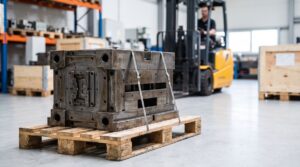

Aluminium die casting (aluminum die casting in US spelling) is how most complex metal housings, brackets, heat sinks and enclosures get made at volume. If a part is a three-dimensional aluminium shape with walls, ribs and bosses — too intricate to stamp, too high-volume to machine from billet economically — it is usually a die casting.
This guide is for procurement managers and design engineers weighing die casting against the alternatives: what the process is, how aluminium compares with zinc, why hot- and cold-chamber machines matter, what the tooling costs, and where die casting beats CNC machining and stamping — and where it doesn’t.
We run die casting alongside injection moulding, metal pressings and CNC at our factory in Shenzhen, and support the Americas from our plant in Querétaro, Mexico. The shop-floor view below is what we tell our own customers before they commit a part to a casting die.
How die casting works
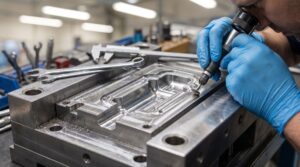
Die casting forces molten metal, under high pressure, into a hardened steel mould (the die) and holds it until the metal solidifies. The die opens, ejector pins push the part out, the excess metal (the biscuit, runners and overflow) is trimmed off, and the cycle repeats — often in well under a minute for a small part.
High pressure is the defining feature. It fills thin walls and fine detail that gravity or low-pressure casting can’t reach, which is why die castings can carry thin fins, tight ribs and net-shape features that would otherwise need machining. The trade-off is turbulence and trapped gas, which is why porosity control — vents, vacuum assist, and gating design — is where a good caster earns its money.
The result is a near-net-shape part: most features come out ready to use, with only critical surfaces, sealing faces and threaded holes needing secondary machining.
Aluminium vs zinc alloys
Aluminium and zinc are the two dominant die-casting families, and they behave very differently. Choosing between them is often the first real decision on a programme.
| Property | Aluminium (ADC12 / A380) | Zinc (Zamak 3 / 5) |
|---|---|---|
| Weight | Light (density ~2.7 g/cm³) | Heavy (density ~6.6 g/cm³) |
| Strength-to-weight | Excellent | Good, but heavy |
| Minimum wall thickness | ~1.2–2.0 mm typical | ~0.6–1.0 mm (thinner possible) |
| Machine type | Cold-chamber | Hot-chamber |
| Tool life | Shorter (high melt temp is hard on dies) | Longer (lower melt temp) |
| As-cast detail / finish | Good | Excellent — fine detail, smooth surface |
| Plating | Harder (needs prep); anodising limited on high-Si alloys | Plates beautifully (bright chrome, etc.) |
| Typical use | Heat sinks, structural brackets, large housings | Small precision parts, decorative hardware, connectors |
The short version: choose aluminium when weight, thermal performance or structural strength matter — heat sinks, automotive brackets, electronics enclosures. Choose zinc when you need fine detail, very thin walls, a superb plated finish, or the longest possible tool life on a small part. Magnesium is a third option where every gram counts, but it’s a specialist route.
Hot-chamber vs cold-chamber
This is a machine distinction that follows directly from the alloy, and it’s worth understanding because it decides cycle time and which supplier can even make your part.
- Hot-chamber — the injection mechanism (the gooseneck) sits in the molten metal bath. Fast cycles, minimal metal handling. Used for low-melt alloys: zinc and magnesium. It cannot be used for aluminium, because molten aluminium chemically attacks the iron of the gooseneck.
- Cold-chamber — metal is ladled into a separate cold shot sleeve for each shot, then rammed into the die at very high pressure. Slower cycle and more handling, but it tolerates the high melt temperatures of aluminium, brass and other high-melt alloys.
So in practice: aluminium die casting is always cold-chamber, and zinc is usually hot-chamber. If a supplier quoting an aluminium part talks about hot-chamber tooling, something is wrong with the conversation.
Tooling
The die is the big up-front investment. Aluminium dies are cut from hardened hot-work tool steel (typically H13) because they take a beating from the high melt temperature and thermal cycling. Key points a buyer should understand:
- Cavitation — a die can be single-cavity or multi-cavity. More cavities means more parts per shot and a lower piece price, but a bigger, pricier tool and a larger press.
- Tool life — aluminium dies typically deliver on the order of 100,000+ shots before major refurbishment; zinc dies last considerably longer because the metal is kinder to the steel. Ask for expected tool life against your annual volume.
- Draft and ejection — cast features need draft angles so the part releases; a good caster designs these in during DFM.
- Trim tooling — a separate, cheaper tool that removes the runners and flash after casting.
Tool cost scales with part size, cavity count, complexity and the number of slides needed for undercuts. As a rough order of magnitude, a straightforward single-cavity aluminium die often lands in the mid five figures (USD); large, multi-cavity or slide-heavy tools go well beyond that. Get the tool quoted against a realistic volume so the amortisation makes sense.
Tolerances, finishes and secondary machining
As-cast die castings are dimensionally good but not machined-precise. Industry linear tolerances (the NADCA standard is the usual reference) run around ±0.1 mm on small dimensions plus an allowance per additional length, with tighter “precision” bands available at added cost. Flatness and true position on critical mating faces usually need machining.
That’s the normal workflow: cast near-net, then machine only what has to be precise. Typical secondary operations:
- CNC machining — sealing faces, bearing bores, threaded holes, and any feature tighter than as-cast capability. This is where a caster with in-house CNC (see our CNC turning parts buyer’s guide for the machining side) saves you a hand-off.
- Deburring and shot blast — removing flash and giving a uniform matte surface.
- Impregnation — sealing micro-porosity for pressure-tight parts (pump bodies, housings that must hold fluid or gas).
- Finishing — powder coat, chromate/conversion coating, and e-coat. Note that anodising is limited on high-silicon casting alloys like A380 — it comes out patchy — so if you need a bright anodised finish, raise it at design time.
Die casting vs CNC machining vs stamping: when to choose each
These three processes overlap at the edges, and the wrong choice is expensive. The decision comes down to geometry, volume and how much of the part needs precision.
| Factor | Aluminium die casting | CNC machining | Metal stamping |
|---|---|---|---|
| Best geometry | Complex 3D shapes, walls, ribs, bosses | Prismatic parts cut from solid billet | Thin sheet formed and bent |
| Volume break-even | High — needs volume to amortise the die | Any volume, including one-offs | High — needs volume to amortise the tool |
| Tooling cost | High (steel die) | None to low (fixtures) | High (press tool) |
| Tolerance as-made | Moderate; tight only where machined | Tightest | Moderate |
| Material utilisation | High — near-net, low scrap | Low — much of the billet becomes chips | Medium — strip scrap |
| Sweet spot | Housings, heat sinks, brackets at volume | Precision blocks, prototypes, low volume | Brackets, clips, shields, panels |
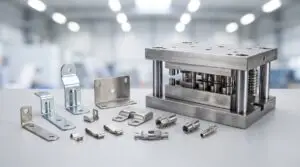
Rules of thumb from the floor: if the part is a complex three-dimensional aluminium shape and you’re making thousands or more a year, die casting almost always wins. If you need only a few hundred, or the whole part must hold tight tolerances, machine it from billet — the tooling saving beats the higher per-part cost. If the part is essentially formed sheet metal, it’s a stamping; our sibling guide on sheet metal stamping and metal pressings covers that route. Many real parts are a blend — cast the body, machine the critical faces — which is exactly why sourcing all three under one roof matters.
Applications
Where aluminium die casting earns its keep:
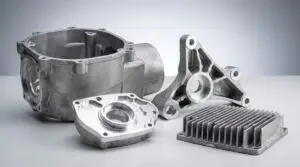
- Housings and enclosures — electronics housings, motor and gearbox casings, instrument enclosures. Thin walls, integrated mounting bosses and connector features come out net-shape.
- Heat sinks and thermal parts — aluminium’s conductivity plus die casting’s ability to hold fine, closely spaced fins makes it the default for LED lighting and power-electronics cooling.
- Structural brackets and mounts — automotive and industrial brackets that need strength-to-weight and consistent geometry across high volume.
- Lighting bodies — commercial and industrial luminaire housings that combine a heat-sink function with the enclosure.
- Pump, valve and manifold bodies — with impregnation for pressure tightness and machined sealing faces.
Cost and volume break-even
Die casting is a high-fixed-cost, low-variable-cost process: you pay a lot for the die, then very little per part. That shape is what drives the break-even against CNC machining, which is the reverse — no tooling, but a high per-part cost.
The crossover depends on part size and complexity, but as a working guide: below roughly a few thousand parts a year, CNC machining from billet often costs less in total once you account for the die. Above that, the die casting piece price pulls away and the tooling amortises quickly. For a small, simple part the break-even can be lower; for a large, slide-heavy die it can be higher. The honest answer is to have both routes quoted at your real annual volume rather than assume.
Two levers that move die-casting economics: cavitation (more cavities lower the piece price but raise the tool cost — worth it at high volume) and secondary machining (every machined feature adds cost, so design out the ones the function doesn’t need). And if you’re also weighing where to make the part — China versus nearshore in Mexico — the total-landed-cost maths matters as much as the piece price; our total cost of China+1 framework walks through that.
Frequently asked questions
Is aluminium die casting cheaper than CNC machining?
At volume, yes — usually much cheaper per part, because you cast near-net-shape and machine only the critical features instead of cutting the whole part from billet. But die casting carries a large up-front tooling cost, so at low volumes (a few thousand parts a year or fewer) CNC machining often wins on total cost. The break-even depends on part size and complexity; quote both at your real annual volume.
Why can’t aluminium be hot-chamber die cast?
Because molten aluminium chemically attacks the iron components of a hot-chamber machine’s gooseneck, which sits permanently in the melt. Aluminium is therefore always cast on cold-chamber machines, where metal is ladled into a separate shot sleeve for each cycle. Zinc and magnesium, with their lower melt temperatures, can run hot-chamber.
What tolerances can aluminium die casting hold?
As-cast linear tolerances run around ±0.1 mm on small dimensions plus an allowance per additional length of the part, with tighter precision bands available at added cost. Anything needing true position, flatness on a mating face, or a threaded hole is normally finished by CNC machining after casting — which is why a caster with in-house machining is worth having.
Can die-cast aluminium parts be anodised?
Only to a limited extent. The high-silicon alloys used for die casting (such as A380/ADC12) anodise unevenly and come out patchy, so they’re usually powder-coated, chromate-coated or e-coated instead. If a bright anodised finish is essential, raise it at design time — it may push the material or process choice.
The bottom line
Aluminium die casting is the right call for complex, lightweight metal parts at volume — housings, heat sinks, brackets and enclosures where near-net-shape saves both material and machining. The economics hinge on volume amortising the tool, and on machining only what genuinely needs precision. Choose aluminium for weight and thermal performance, zinc for fine detail and finish, and always quote die casting against CNC and stamping when the geometry is borderline. The biggest wins come from a partner who can cast, machine and finish the part in one place rather than shipping it between vendors.
Get a die casting estimate from a factory that owns its process
If you’re sizing a die casting programme — a new part, a transfer from another supplier, or a make-versus-machine decision — we can give you a process estimate from our own shop floor. A real engineer reviews your drawing, advises on alloy, wall thickness, draft and which features to machine versus cast, and gives you a breakdown by tooling, material and piece price. Not a brokered quote with a markup.
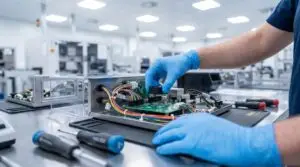
We run die casting, CNC, moulding, pressings and assembly under our own roofs in China and Mexico — so a cast-and-machined part, or a full sub-assembly (see box build and electromechanical assembly), can come from one partner. For the wider case on why that choice matters, see why choosing the right manufacturing partner matters. ISO 9001 certified, Sedex audited, making things better for OEM customers since 2003. NDA available before drawings change hands.