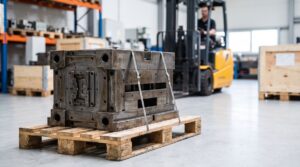

Moving an injection mould from one factory to another is one of those jobs that sounds simple and rarely is. The tool is a physical asset — you can crate it and ship it. But the tool is only half of what makes good parts. The other half is the process knowledge, the setup parameters, the qualification history and the tribal know-how that lives in the factory that’s been running it. Transfer the steel without transferring the knowledge, and you inherit a tool that doesn’t quite run right and nobody left who knows why.
Done properly, though, a tool transfer is a controlled, low-drama project that ends with parts as good as — or better than — before, from a supplier you’d rather work with. This guide walks through why OEMs move tooling, the risks to check before you commit, how a transfer actually runs step by step, how the receiving factory re-qualifies the tool, how to avoid a production gap, and exactly what to demand from the factory taking your tool on. It’s written for the procurement and engineering leads who have to make the call and live with the result. (US readers: “injection mould transfer” and “injection mold transfer” are the same thing — UK spelling here, identical work.)
Why OEMs move tooling to a new supplier
Nobody transfers tooling for fun — there’s always a driver strong enough to overcome the inertia of leaving a tool where it sits. The common ones:
- Quality problems. Persistent defects, rising reject rates, drifting dimensions or a supplier who can’t or won’t fix root cause. When the parts stop meeting spec and the conversations stop being productive, the tool moves.
- Cost. Piece-price creep, opaque pricing, or a more competitive quote elsewhere. Tooling transfer is often the mechanism for realising a cost saving that a re-quote alone can’t unlock.
- Service and communication. Missed deliveries, slow responses, language and time-zone friction, no engineering input when you need it. Reliability and responsiveness matter as much as price over the life of a programme.
- Supply-chain risk and China+1. Concentration risk, tariff exposure and the drive to nearshore. Many transfers today are about moving tooling out of a single-country footprint — or closer to the end market — rather than any fault with the current supplier. Choosing where the tool lands is a strategic decision, which is why choosing the right manufacturing partner matters more than the transfer mechanics themselves.
- Supplier exit or consolidation. A supplier going out of business, exiting your product area, or your own decision to consolidate a fragmented supply base under fewer, stronger partners.
Before you commit: the pre-transfer risk checklist
The failures in a tool transfer are almost always failures of preparation, not execution. Work through this checklist before anything moves.
- Confirm tool ownership and get it in writing. This is the one that stops transfers dead. Make sure you legally own the tool, that there are no outstanding payments giving the current supplier a lien, and that you have a written agreement to release it. Sort this first — everything else is wasted effort if the tool won’t leave.
- Establish the tool’s true condition. A transfer is the perfect moment for wear you don’t know about to surface. Get shot count, maintenance history and recent sample parts. Assume the tool may need repair or refurbishment on arrival, and budget for it.
- Gather the documentation package. Tool drawings, 2D/3D data, material specifications, approved setup sheets and process parameters, the qualification and inspection history, and any known-issue notes. The more of this you secure before the relationship cools, the smoother the transfer.
- Capture the baseline. Golden samples, current dimensional reports and capability data. You can’t prove the new supplier matches the old one without a documented “before”.
- Map spares and hot-runner details. Ejector pins, hot-runner components, controllers and their settings. Missing spares and undocumented hot-runner setups are classic post-transfer surprises.
- Plan the production bridge. Decide how much safety stock you need to cover the transfer window before a single part stops being made at the old supplier (more on this below).
How a tool transfer works, step by step
A well-run transfer follows a predictable sequence. Here’s the shape of the project.
- 1. Assessment and planning. The receiving factory reviews the tool data, part requirements and volumes, identifies risks, and produces a transfer plan with timeline, responsibilities and a re-qualification approach. This is where a good receiving partner earns their place — by telling you what could go wrong before it does.
- 2. Documentation handover. The full package moves across: drawings, data, material specs, process parameters and history. Gaps are identified and closed now, not discovered at first trial.
- 3. Physical transfer. The tool is prepared, protected against corrosion, crated and shipped, with customs and logistics handled. Transit time and distance are a real factor here — a nearshore destination shortens this stage dramatically.
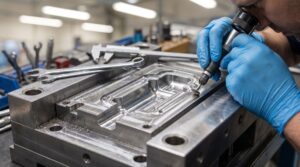
- 4. Incoming inspection. On arrival the tool is stripped, cleaned and inspected against its drawings. Wear, damage and missing components are documented, and any repair or refurbishment is agreed before the tool goes near a press.
- 5. Sampling trial (T1). The tool runs its first trial at the new factory. Parts are measured against the drawing and the golden samples, and the process is dialled in to reproduce good parts consistently.
- 6. Re-qualification and approval. Formal validation — first-article inspection, capability studies and PPAP as required — proves the tool makes conforming parts at the new home. Only then does the tool go to production.
- 7. Production handover. Approved parameters are locked in, the tool enters the new supplier’s maintenance programme, and serial production resumes.
Re-qualification: first-article inspection, capability and PPAP
This is the step that makes a transfer safe, and the one procurement teams most often underestimate. Moving a tool voids the assumption that it still makes good parts — you have to prove it again at the new factory, on the new presses, with the new process. Re-qualification is that proof.
- First-article inspection (FAI). A full dimensional and functional inspection of the first parts off the transferred tool, checked against every drawing characteristic. It confirms the tool reproduces the part correctly in its new home.
- Process capability. Short studies (Cpk/Ppk on critical dimensions) show the process is not just making good parts today but is stable and repeatable enough to keep making them.
- PPAP (Production Part Approval Process). In automotive and other regulated sectors, the formal PPAP package — FAI, capability data, material certs, process documentation and control plan — is the deliverable that formally approves the transferred tool for production. Agree the required PPAP level up front so it’s built into the plan, not bolted on at the end.
Comparing new parts against your documented baseline — the golden samples and pre-transfer reports — is what turns “looks fine” into “proven equivalent or better”. Skip this and you’re gambling that nothing changed in the move. Something usually did.
Avoiding production downtime during the transfer
The fear that stops most transfers isn’t quality — it’s the gap. What if the line stops while the tool is in transit and re-qualification? Managed properly, the answer is: it doesn’t. The tools for keeping supply unbroken:
- Build a bridge stock. Before the tool leaves the current supplier, run enough safety stock to cover the entire transfer and re-qualification window, plus a margin. This is the single most effective protection against a supply gap.
- Sequence the move, don’t gamble it. Keep production running at the old supplier until the new supplier has passed re-qualification and proven conforming parts. Only then switch over. Never leave yourself with no source of parts mid-transfer.
- Front-load the risk work. Close documentation gaps and agree the repair scope before the tool ships, so trials aren’t delayed by surprises the first time the tool opens at the new factory.
- Shorten the transit. Distance is downtime risk. Moving a tool across the Pacific adds weeks of freight and customs each way; a nearshore transfer compresses that window and shrinks the bridge stock you need to carry.
What to demand from the receiving factory: a checklist
The receiving factory makes or breaks the transfer. Before you hand over your tool, insist on all of the following. If a prospective partner hesitates on any of them, treat it as a warning.
- A written transfer plan — timeline, milestones, responsibilities and risk register, not a verbal reassurance.
- In-house toolmaking capability — a real tool room that can inspect, repair, refurbish and re-engineer your tool on site, not a moulder who sub-contracts tooling work out.
- Documented incoming inspection — a written condition report on arrival, before any production, so you know exactly what state your tool reached them in.
- A defined re-qualification protocol — FAI, capability studies and PPAP to the level your sector requires, agreed up front.
- Baseline comparison — a commitment to measure new parts against your golden samples and pre-transfer data and show you the results.
- Direct engineering access — English-speaking engineers you can talk to directly, without a broker or translation layer between you and the people running your tool.
- Quality credentials — ISO 9001 as a baseline, plus any sector-specific standards (IATF 16949 for automotive, ISO 13485 for medical).
- Ongoing maintenance — the tool entering a documented preventive-maintenance programme, so the problems that may have prompted the move don’t reappear.
- Transparent pricing — clear transfer costs, repair scope and piece price, with the same total-cost logic that governs injection mould tooling cost generally.
How Sino handles tool transfers
Sino has taken on, re-qualified and run transferred tooling for over 23 years — for OEMs including Jaguar Land Rover, Toyota, BMW and Ford — from ISO 9001:2015-certified factories we own and operate in Shenzhen, China and Querétaro, Mexico. Because we’re makers with our own tool rooms, an incoming tool goes to toolmakers who can inspect it, repair or re-engineer it, and prove it out — not to a service desk that sub-contracts the real work.
Our Querétaro facility makes Sino a natural home for China+1 and nearshoring transfers: manufacturers moving tooling closer to the US and Canadian markets get shorter transit, USMCA-friendly terms and English-speaking engineers, with the same British-managed engineering standard we run in Shenzhen. It’s the practical route into manufacturing in Mexico without starting your product from scratch. And because we run our own preventive-maintenance discipline, a transferred tool doesn’t just survive the move — it enters a programme built to keep it running for years.
Every transfer starts the same way: with an honest assessment of your tool, your risks and your options — before anything moves. Request a tool-transfer assessment and we’ll tell you plainly what’s involved, what it will cost, and how we’ll keep your line running throughout.
Frequently asked questions
How long does an injection mould transfer take?
Typically several weeks to a few months, depending on the tool’s condition, the re-qualification required and the distance moved. The physical shipment is often the smallest part; documentation handover, incoming inspection, any repair, sampling trials and PPAP drive the timeline. A nearshore transfer with a clean documentation package and a sound tool moves fastest.
Will transferring my tooling cause a production gap?
It shouldn’t, if it’s managed properly. Build enough bridge stock to cover the full transfer and re-qualification window before the tool leaves, and keep the old supplier producing until the new supplier has passed re-qualification. You only switch over once conforming parts are proven — so there’s no window with no source of parts.
Who owns the injection mould — us or the supplier?
If you paid for the tool, you almost certainly own it — but confirm it in writing before planning a transfer. Check for outstanding payments that could give the current supplier a lien, and get a written release. Ownership disputes are the most common thing that stalls a transfer, so resolve it first.
Does a transferred tool need PPAP again?
In automotive and other regulated sectors, yes — moving a tool to a new factory and new presses requires re-qualification, and PPAP is how that approval is documented. The exact level depends on your customer and sector. Even outside formal PPAP, first-article inspection and capability studies are strongly advised to prove the tool makes conforming parts in its new home.
Can I transfer a tool from China to Mexico?
Yes — it’s an increasingly common China+1 move. Sino can receive tooling from another supplier into our Querétaro facility, inspect and re-qualify it, and run production nearshore to the US and Canadian markets on USMCA-friendly terms, with the same engineering standard as our Shenzhen operation.
The bottom line
A tool transfer is a knowledge transfer that happens to involve a crate. Move the steel and leave the process behind, and you inherit somebody else’s problems; move both, with ownership confirmed, documentation secured, bridge stock in place and re-qualification proven, and you end up with better parts from a partner you’d rather work with — often closer to your market. The mechanics are manageable; the discipline is what matters. Request a tool-transfer assessment and we’ll map your specific transfer honestly — risks, cost, timeline and how we keep your line supplied from first crate to first approved production part.
Need help with a project?
Choosing the right moulding method is crucial. Whether you need durable automotive parts, precision electronics components, or customised medical devices — Sino’s team will help you get it right from the start.
We’ll complete an NDA and provide expert advice tailored to your requirements, timescale and budget.