
Box build assembly is where a project stops being a pile of parts and becomes a finished product. It is the stage that takes moulded enclosures, machined and pressed metalwork, populated circuit boards, cables, fasteners and labels, and turns them into a boxed, tested unit ready to ship to your customer or straight onto a shelf.
For a procurement or engineering lead, box build (also called electromechanical assembly, or EMA) is also where sourcing gets complicated fast. A single finished unit can pull components from four or five different suppliers, each with its own lead time, quality record and country of origin. This guide is for buyers scoping a box build programme: what the process actually covers, how sub-assembly differs from full box build, what to check before you commit, and why consolidating the work under one roof usually beats managing a chain of separate vendors.
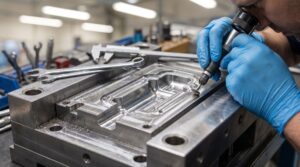
We run electromechanical assembly alongside injection moulding, metal pressing, CNC turning and die casting at our Shenzhen factory, with mould repair and nearshore support from our Querétaro site in Mexico. The view below is what we tell our own customers when they ask, “What should I be checking before I hand over the whole build?”
What box build and electromechanical assembly cover
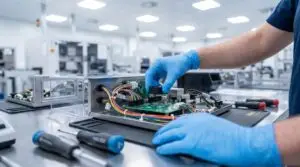
Box build is the assembly of a complete product from its constituent parts — mechanical, electrical and electronic — into a finished, tested unit. “Electromechanical assembly” is the same work described from the engineering side: joining electrical and electronic components to mechanical structures. In practice the terms are used interchangeably, and most real programmes involve both.
A typical box build scope pulls together some or all of the following:
| Element | What it involves | Where the parts come from |
|---|---|---|
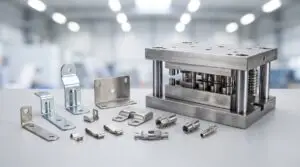
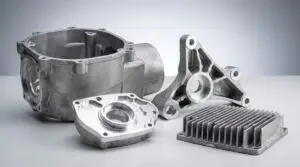
| Enclosure | Moulded housings, metal chassis, brackets, fascias, gaskets | Injection moulding, metal pressing, die casting |
| Electronics | Populated PCBAs, power supplies, displays, sensors | PCB assembly (in-house or supplied) |
| Interconnect | Cables, wire harnesses, connectors, terminals | Cable and harness assembly |
| Hardware | Fasteners, standoffs, seals, thermal pads, labels | Turned parts, bought-in components |
| Assembly & test | Mechanical build, wiring, functional test, packing | The assembly line itself |
The point of the table is simple: a box build touches almost every process a contract manufacturer offers. That is exactly why it is either your easiest programme to manage or your hardest — depending on whether one partner controls those processes or five different ones do.
Sub-assembly vs full box build
Not every project needs a complete finished unit. The two most common levels of scope are sub-assembly and full box build, and they carry very different cost, control and logistics implications.
| Sub-assembly | Full box build | |
|---|---|---|
| Scope | A completed module — e.g. a wired enclosure, a display bezel, a valve-and-harness assembly | The entire product, assembled, tested, packed and labelled |
| You still do | Final integration, functional test, packaging | Nothing — the unit ships ready for the end customer |
| Best when | You own final assembly, or split the build across regions | You want a single part number and one supplier accountable for the finished product |
| Typical test | Continuity, fit, sub-function | Full functional and end-of-line test to your spec |
| Logistics | Modules ship to your line | Finished goods ship to your warehouse or drop-ship to customers |
A practical way to decide: if you are managing more than two suppliers to build one module, that module is a candidate for sub-assembly by whoever makes most of its parts. If you are managing several suppliers to build the whole product, and your own team spends real time babysitting that chain, full box build is usually the cheaper answer once you count the coordination cost — the subject of our total cost of China+1 framework.
Inside a box build: the three areas that make or break it
Three parts of a box build cause most of the quality problems we see when a programme transfers to us from another supplier. Get these right and the rest of the build is straightforward.
PCBA integration
The printed circuit board assembly is usually the most expensive and most delicate item in the box. Integrating it well means more than screwing it to a boss. It means controlling ESD on the line, protecting connectors during handling, managing conformal-coated boards carefully, and confirming firmware or configuration where required. A good EMA partner will either populate the PCBA in-house or work to a clear incoming-inspection standard on boards you supply. Either way, ask how boards are handled, stored and tested before they go into the enclosure — a rejected unit at end-of-line has already absorbed the cost of every part in it.
Cable and wire-harness assembly
Cables and harnesses are the quiet source of field failures. Crimp quality, correct pinout, strain relief, connector seating and continuity all matter, and none of them are visible once the box is closed. Look for crimp-height verification, pull testing to a defined force, 100% continuity testing on harnesses, and clear work instructions with poka-yoke fixtures so a harness can only be built one way. If your product carries current, or lives in a vibrating or automotive environment, this is where you push hardest on process discipline.
Functional testing and QC
The difference between a parts-assembler and a real box build partner is testing. Sub-assembly might only need continuity and fit checks. A full box build should be functionally tested to your specification at end of line — power-up, key functions, safety checks, and any calibration the product needs — with results recorded and traceable to the unit. Ask what the test covers, whether it is a documented test with pass/fail criteria (not an operator’s judgement), and whether failures are logged and analysed. Traceability matters: if a field issue arises, you want to trace a serial number back to the build lot, the PCBA batch and the test record.
The real value: consolidating suppliers under one roof
Here is the argument for box build in one sentence: every supplier boundary in a product is a place where cost, delay and blame accumulate.
Run a typical multi-part product across separate vendors and you inherit their combined problems. The moulder blames the metal supplier for a fit issue. The harness shop and the PCBA house each point at the other when a unit won’t power up. Freight moves between them, each leg adding time, cost and a chance to damage parts. Your team becomes the integrator of last resort — chasing dates, reconciling revisions, and owning every gap between suppliers that none of them will own.
Consolidating moulding, metalwork and assembly under one partner removes those boundaries. One team controls the enclosure, the metal, the sub-assemblies and the final build, so fit and tolerance issues get resolved between benches rather than between companies. One quality system covers the whole unit. One shipment leaves the factory instead of four converging on your dock. And when something does go wrong, there is one company accountable for the finished product — not a finger-pointing exercise across a supply chain you have to referee. This is why the partner choice matters more than most single engineering decisions, a case we make in full in why choosing the right manufacturing partner matters.
How to evaluate a box build / EMA partner
Use this checklist when you shortlist. The goal is to separate a genuine multi-process manufacturer from an assembler who will quietly broker out everything they can’t do themselves.
| Area | What to verify |
|---|---|
| In-house processes | Which processes are actually done under their roof — moulding, metal, machining, assembly? Ask what gets sub-contracted and to whom. |
| PCBA capability | Do they populate boards in-house or receive them? What is the incoming-inspection standard? |
| Harness & cable | Crimp verification, pull testing, 100% continuity, poka-yoke fixturing. |
| Test | Documented functional test with pass/fail criteria; results traceable to each unit. |
| Quality system | ISO 9001:2015 minimum; industry-specific certs (IATF 16949, ISO 13485) if you need them. Current, accredited, with auditor’s report on request. |
| Traceability | Serial-level records linking unit, component lot, and test result. |
| Kitting & BOM | Who owns the bill of materials, buys the components, and holds inventory? |
| Logistics | Finished-goods packing, labelling, and shipping — plus country of origin and USMCA/tariff position. |
| Engineering contact | A named engineer you can reach directly, in your language, without a translation gap. |
The single highest-signal question: “Which of these processes do you own, and which do you buy in?” A real multi-process manufacturer answers plainly and invites you to walk the floor. An assembler-broker gets vague. The same test applies whether you are sourcing a full build, sheet metal stamping for the chassis, or aluminium die casting for structural housings.
Kitting and logistics
Two parts of box build get under-scoped in most RFQs, and both drive real cost: kitting and finished-goods logistics.
Kitting is the discipline of getting every component to the assembly line at the right time, in the right quantity, matched to the right build. On a box build with dozens of line items, a single missing fastener or a wrong-revision label stops the whole line. Decide early who owns the bill of materials and the purchasing: if your partner buys and holds the components, you get one accountable inventory and far less coordination on your side. If you consign parts, you keep control but take on the shortage risk. Neither is wrong — but it should be a decision, not an accident.
Logistics is where the finished unit meets your supply chain. A full box build should leave the factory packed to your specification, labelled, and — where it matters — palletised and manifested for your warehouse or for drop-ship to customers. Country of origin belongs in this conversation too: a unit built in China and one built or finished in Mexico can carry very different tariff and USMCA treatment. A partner with both China and Mexico capability lets you place the final assembly where the landed cost and origin rules work in your favour.
Where Sino Manufacturing fits
For buyers who haven’t worked with us before, the short version of what we are and aren’t:
- We own our factories. 5,000 m² (54,000 sq ft) in Shenzhen, operating since 2003, plus a Querétaro site in Mexico. Not a broker, not a marketplace.
- Multi-process under one roof. Injection moulding, metal pressing, CNC turning, die casting and electromechanical assembly — so a box build’s parts are made and assembled by one accountable team, not stitched together across vendors.
- British-Chinese leadership. British engineers and project managers running operations in-house, with English-speaking technical contact across the UK, Europe, Mexico, North America, Canada and China. No translation gap on engineering calls.
- ISO 9001:2015 certified, Sedex audited. Auditor’s reports available on request.
- Customers include Jaguar Land Rover, Toyota, BMW, Ford, Honeywell and GE — programmes in automotive, medical, industrial and electronics.
- China + Mexico capability. Place production and final assembly where the landed cost, lead time and USMCA origin rules work best for the programme — the China+1 hedge in practice.
If you are earlier in the process and still weighing single-process suppliers against one multi-process partner, our turned parts manufacturer selection guide walks through the same audit framework for a single process.
Frequently asked questions
What is box build assembly?
Box build assembly is the process of building a complete product from its individual parts — enclosures, circuit boards, cables and harnesses, mechanical hardware and labels — into a finished, tested and packed unit ready to ship. It is often called electromechanical assembly (EMA) because it joins electrical and electronic components to mechanical structures. Scope ranges from a single wired sub-assembly up to a fully tested, boxed product.
What is the difference between sub-assembly and full box build?
A sub-assembly is a completed module — such as a wired enclosure or a display bezel — that you then integrate into the final product yourself. A full box build is the entire product, assembled, functionally tested, packed and labelled, so it ships ready for the end customer. Sub-assembly suits buyers who own final assembly or split the build across regions; full box build suits buyers who want one supplier accountable for the finished unit.
Should I use one supplier for the whole box build or several specialists?
For most multi-part products, one multi-process partner beats a chain of specialists once you count the true cost of coordination — chasing dates, reconciling revisions, freight between vendors, and owning the gaps none of them will. Separate specialists can make sense when a component is highly specialised or already single-sourced elsewhere. The deciding factor is usually how much of the build one partner can genuinely make in-house rather than broker out.
Can a box build be split between China and Mexico?
Yes, and for many buyers it is the smart play. High-volume production where unit cost dominates often stays in China, while final assembly, mould repair or nearshore builds run from Mexico for shorter lead times and USMCA-friendly country of origin. A partner with both locations lets you place each stage where the landed cost and tariff rules work in your favour, rather than forcing the whole programme into one country.
The bottom line
Box build and electromechanical assembly are where the value of a one-partner, multi-process manufacturer becomes obvious. The work touches nearly every process in a factory, and every supplier boundary you remove takes cost, delay and blame out of the programme with it. When you evaluate a partner, look past the assembly line itself: verify which processes they truly own in-house, how they handle PCBA integration and harnesses, whether they functionally test and trace each unit, and who owns kitting and logistics. Specify the finished unit and let one accountable team build it — that is the whole point of box build.
Get a process estimate from a factory that owns its lines
If you’re scoping a box build or electromechanical assembly programme — a first build, a transfer from another supplier, or a fresh sourcing exercise — we can give you a process estimate from our own shop floor.
What that means in practice: a named engineer reviews your bill of materials and drawings, flags any DFM, test or kitting questions, and returns a breakdown by component, assembly and test — plus a view on whether China, Mexico, or a split of the two gives you the best landed cost. Not a brokered quote with a hidden markup. An estimate from the people who would actually build the units.
We’re ISO 9001:2015 certified, Sedex audited, and have been making things better for OEM customers since 2003 — JLR, Toyota, BMW, Ford, Honeywell and GE among them. NDA available before drawings change hands.
Need help with a project?
Choosing the right assembly partner is crucial. Whether you need a wired sub-assembly, a fully tested box build, or a multi-process programme spanning moulding, metal and assembly — Sino’s team will help you get it right from the start.
We’ll complete an NDA and provide expert advice tailored to your requirements, timescale and budget.