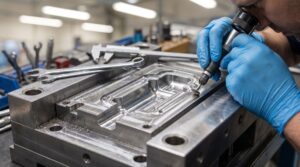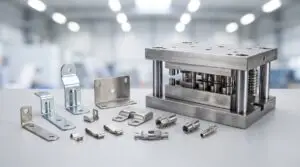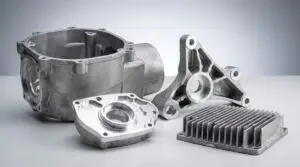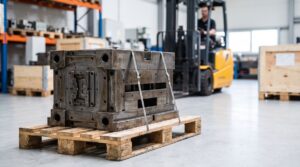

Aluminium die casting is a manufacturing process in which molten aluminium is injected into a mould cavity under high pressure, allowing for the creation of intricate, highly accurate components. The moulds (typically made from hardened steel) enable the high-volume production of uniform parts, making die casting a cost-effective and efficient method for producing durable lighting fixtures.
Another common method, aluminium extrusion, involves heating aluminium alloys and forcing them through a die to create long sections with a fixed cross-sectional profile. While extrusion is suitable for simpler, linear designs, it lacks the design flexibility of die casting and often requires additional machining and assembly, increasing production costs overall.
This blog will explore why the excellent thermal conductivity, lightweight nature, and strength of aluminium die casting make it the preferred method for long-lasting, high-performance LED light fixtures.
Methodology of Aluminium Die Casting for Lighting
The die casting process begins with a precision-engineered steel mould. Into this, molten aluminium is injected under high pressure to form complex, durable components. Once the metal cools and solidifies, the part is ejected, trimmed, and finished through machining, shot blasting, or coating for enhanced durability and aesthetics. Finally, quality checks ensure dimensional accuracy and structural integrity before final assembly. This method enables the high-volume production of strong, lightweight, and thermally efficient LED housings and fixtures, making it the ideal choice for modern lighting solutions.
Benefits of this method
Aluminium Die Casting is a highly valued method because it allows for the efficient production of lightweight, strong, and complex metal parts with high dimensional accuracy, and it’s used in nearly every industry. Let’s dive into the main benefits of this technique and why it is so well suited for lighting:
Strength and Durability
Aluminium die-cast parts are renowned for their exceptional strength and durability. They are designed to endure harsh environmental conditions, offering excellent resistance to corrosion. This makes them particularly well-suited for outdoor applications, where reliability and longevity are essential.
Cost Effective for Mass Production
The initial mould is the most expensive part of die-casting. Once this is created, the per unit costs of die-cast parts are relatively low. Cheap production and minimal machinery make this great for mass production.
Precision and Accuracy
The die-casting process allows for the production of intricate parts with tight tolerances and complex geometries. This precision reduces the need for additional machining and ensures that the parts fit together perfectly.
Cons of this method
High Upfront Cost
Creating the moulds for die casting can be expensive, especially for complex designs. This can be a barrier for small production runs.
Weight Limitations
While aluminium is lightweight compared to other metals, it may still be too heavy for some applications where ultra-lightweight materials (such as plastics or composites) are preferred.
Post-Processing Needs
Although die casting produces precise parts, there might still be a need for post-processing (such as trimming, machining, or surface finishing) which adds to production time and cost.
Aluminum die casting stands out as the ideal manufacturing process for lighting applications due to its unique combination of strength, durability, and thermal efficiency. It has excellent heat dissipation properties, making it perfect for LED and high-intensity lighting, ensuring longevity and optimal performance. Although this method can have a high upfront cost and additional post processing needs, these drawbacks don’t outweigh the many benefits of this technique. It’s clear that this method is worth the money due to the mass production productivity and durability of all parts.
Contact our specialists to find out more about our Die-Casting Technique.