
Electromechanical assembly is vital across many industries due to its ability to create complex, functional systems by integrating electrical and mechanical components. This integration is used for a wide range of applications, from everyday devices to industrial machines. However, their assembly can come with significant challenges – they require high levels of precision, accuracy, and consistency to be effective. Throughout this blog, we will be exploring the potential challenges you might come across with electromechanical assembly and ways they can be avoided with correct preparation.
Prototype vs. Production
Prototypes are early-stage models used for testing and refining designs, often involving flexible materials and manual testing. Production models are the final, market-ready products manufactured in high volumes using automated processes.
The prototype stage is essential because…
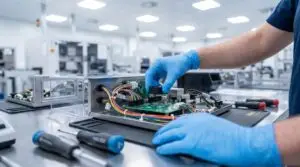
- It catches design problems early on: The prototype identifies mismatched tolerances between parts, and can catch wiring or electrical noise issues early on. The prototype stage is also open to user feedback that can be incorporated into design changes, resulting in a more user-friendly product.
- It refines assembly methods: By building a physical prototype, engineers can identify potential problems with component fit, alignment and connections. Prototypes help to optimise the build process before scaling, preventing future issues down the production line.
Learn more about what electromechanical assemblies are, the common types, and their key advantages and disadvantages.
Steps to streamline the Electromechanical Assembly Workflow:
Transitioning from prototype to production requires more than just a refined design; it demands a well-structured workflow that reduces risk, saves time, and ensures product reliability. Below are key steps that can significantly streamline your electromechanical assembly process, enabling you to transition from small-batch prototypes to full-scale production with confidence and control.
Design for manufacturability
This is one of the most important principles when transitioning from prototype to production. It’s all about making a product that can be built efficiently and repeatedly, using the available tools and machinery. It’s essential to consider design factors such as accessibility, orientation, and spacing to enhance overall efficiency.
Consider component sourcing
This is crucial because it helps to mitigate risks associated with component availability, quality, and price fluctuations. The last thing you want to do is waste your time trying to find another supplier or dealing with supply chain issues after production has already started.
Quality Control and Testing
Electromechanical assemblies are complex and involve numerous components, so testing ensures that the final product functions as intended without defects. Quality control minimises the risk of product failure, and helps to maintain customer satisfaction, whilst remaining compliant with industry standards.
What happens if you skip the prototype stage?
All the steps we have discussed in this blog emphasise why the prototype stage is so crucial in the workflow of electromechanical assembly. Without this stage you significantly increase the risk of costly errors, delays, and incorrect designs during the later stages of production. Skipping the prototype stage might sound like a good idea to speed up production, but you are actually doing the opposite, leading to expensive consequences down the line.
This blog has explained how electromechanical assembly is a complex process that creates reliable, high-performing products across various industries. It’s clear that you should invest time in the prototype stage to set the foundations for a smoother, more cost-effective transition to production. Streamlining your workflow isn’t just about speed; it’s also about reducing risk and ensuring long-term success.
To find out more, get in touch with our team of experts who will be happy to help.